
How to Manage a 20-Person Team Effectively
If you’re still running weekly 1:1s with all 20 people on your team, that’s over 8 hours a week gone before you’ve reviewed a single piece of work or made a single decision. Most managers hit this wall around the 15 to 20 person mark and try to fix it with better tools or longer hours. Neither works, because the problem isn’t effort. It’s that the playbook that worked at 5 or 10 people simply doesn’t scale to 20 without changing.
Why Managing 20 People Is Different From Managing 5
Management research has circled around the same range for decades: one person can supervise roughly 5 to 9 people directly before coordination overhead starts eating more time than the actual work, a pattern manager-engagement data from Quantum Workplace backs up. Below that number, you can hold context on every project, every relationship, every open issue in your head. Above it, you can’t, and pretending you still can is where most of the dysfunction on a growing team starts.
At 20 people, you’re not stretching that limit. You’re blowing past it by a factor of two or three. If you’re still trying to be the single point of contact for every task, every question, every approval, the math simply doesn’t work anymore, no matter how good you are at your job.
This is the part nobody wants to hear when their team crosses that line: the problem usually isn’t a communication issue or a motivation issue. It’s a structure issue. Fix the structure and half the “communication problems” disappear on their own.
Structure Your Team Before You Try to Manage It
Here’s the uncomfortable truth. Most managers try to fix a 20-person team with better communication tools or more frequent check-ins, when the actual fix is upstream of both: you need sub-teams. For a deeper look at how this plays out across different org shapes, see how organizations should structure teams and sub-teams.
When to introduce sub-teams or leads
The trigger point isn’t a magic number, but it’s close to where the span-of-control research already points, around 8 to 10 direct reports. Past that, introduce a layer. This can be:
- A senior team member who takes on informal lead responsibilities for a group of 4-6 people
- A formal team lead role with its own scope, reviews, and decision authority
- Project-based pods that reform depending on what’s shipping
Pick based on how stable your workstreams are. If the same 4-5 people work together for months at a time, formal pods make sense. If people rotate across projects constantly, a rotating lead model works better.
A sample structure for a 20-person team
One workable pattern: 4 pods of 5, each with a lead, all reporting to you. You now manage 4 people directly instead of 20. Each lead manages 4. Nobody is drowning.
This isn’t the only structure that works, and it won’t fit every team. A support organization might split by shift instead of by pod. An engineering team might split by product surface. The point isn’t the specific shape, it’s that some layer exists between you and 20 individual relationships.
| Layer | Who’s in it | Reports to | Direct reports per person |
|---|---|---|---|
| You | 1 manager | N/A | 4 (the pod leads) |
| Pod leads | 4 leads | You | 5 (their pod) |
| Team members | 16 people | Their pod lead | 0 |
Communication Systems That Scale Past 10 People
The 1:1 math nobody does
Do the arithmetic once and you’ll never go back to weekly 1:1s with 20 people. Even a lean 25-minute 1:1 with everyone, every week, costs you over 8 hours a week in meetings alone before you’ve reviewed a single piece of work, answered an email, or made a single decision. Add prep time and follow-ups and you’re closer to 10-12 hours. That’s a quarter to a third of your week gone before the actual job of managing starts.
The fix isn’t cutting 1:1s. It’s redistributing them. If you’ve built the pod structure above, your leads run weekly 1:1s with their 4-5 people. You run 1:1s with your 4 leads weekly, and biweekly or monthly with everyone else, rotating so nobody goes more than a month without direct facetime with you.
Async first, meetings second
At 20 people, status updates delivered live in a meeting are one of the least efficient uses of everyone’s time. A written weekly update, even a short one, gives you the same information in a fraction of the time and creates a record you can search later. Save live time for decisions, blockers, and anything that needs back-and-forth. The same logic applies to notification noise: see how excessive email notifications hurt productivity for why fewer, better-timed updates beat a constant stream of pings.
Delegation and Task Distribution
The pod structure only works if you actually delegate decisions along with the tasks. This trips up more managers than it should. They’ll happily hand off the work but keep every approval routed through themselves, which recreates the exact bottleneck the structure was supposed to fix.
A common pattern worth watching for: a manager sets up team leads, then still gets copied on every client email, every ticket update, every minor decision “just to stay in the loop.” Within a month the leads stop making decisions at all, because why bother when it all gets reviewed anyway. If you build a layer of leads, give them real authority over their pod’s day-to-day calls. Reserve your involvement for the decisions that actually need your context: budget, hiring, cross-pod conflicts, anything client-facing at a strategic level. Standardizing the repeatable parts of that handoff helps too, see why task templates save repetitive work and what belongs in a good one.
Which Management Style Holds Up at This Size
Most guides on team management walk through the standard styles: authoritative, democratic, laissez-faire, transactional, and coaching. All five are real and all five have their place. What changes at 20 people is which ones you can afford to run yourself, and which ones only work when delegated.
Democratic management, where you involve the whole team in decisions, gets expensive fast past a certain size. Getting input from 20 people on every call slows decisions to a crawl. It still works within a pod of 5, run by the lead, but not as your default style across the whole team.
Laissez-faire has the same problem in reverse. It works well with a small group of highly self-directed people you know well. Stretch it across 20 people you can’t watch closely and it turns into “nobody actually knows what’s going on,” fast.
Coaching scales the best, but only if you stop trying to coach all 20 people yourself. Delegate coaching responsibility to your leads for their own pods, and reserve your own coaching time for the leads themselves. You end up coaching 4 people well instead of 20 people badly.
| Style | Works well at 5 people | Works well at 20 people | Who should run it |
|---|---|---|---|
| Authoritative | Yes | Yes, for overall direction | You, at the whole-team level |
| Democratic | Yes | Only within a pod | Pod leads, within their pod |
| Laissez-faire | Yes, with self-directed people | Rarely, oversight gets too thin | Pod leads, case by case |
| Transactional | Yes | Yes | You, for team-wide goals and metrics |
| Coaching | Yes | Only if delegated | Pod leads for their pod, you for leads |
Tools for Managing a Team of 20
A spreadsheet and a group chat can carry a 5-person team a long way, and a few options are worth knowing if you’re at that stage, see 9 project management tools for startups in 2026. At 20 people split across pods, the requirements change: you need visibility across sub-teams without having to ask each lead for a status update, you need to see where dependencies between pods are creating bottlenecks, and you need reporting that doesn’t require you to manually stitch together four different views.
This is the exact gap that pushes growing teams toward a proper project management system rather than a patchwork of docs and chat threads, one built around how teams connect projects, tasks, events, and knowledge in one place. A PMS like the one we run at one.techxaro.com is built around this cross-pod visibility problem specifically: leads manage their own pod’s day-to-day inside their own workspace, while you get a rolled-up view across all four without chasing anyone for an update. That’s the difference between a tool that works at 5 people and one that still works at 20. If you’re still comparing options, how to choose the right project management software for your team walks through the decision in more depth.
| Requirement | At 5 people | At 20 people |
|---|---|---|
| Task tracking | A shared doc or spreadsheet | A shared system with per-pod views |
| Status visibility | Ask people directly | Rolled-up reporting across pods |
| Dependency tracking | Rarely an issue | Needed, or pods build conflicting work |
| Communication | One group chat | Pod-level channels plus a team-wide one |
| Reporting to stakeholders | Manual, ad hoc | Needs to pull from the system directly |
Common Mistakes When Scaling Team Management
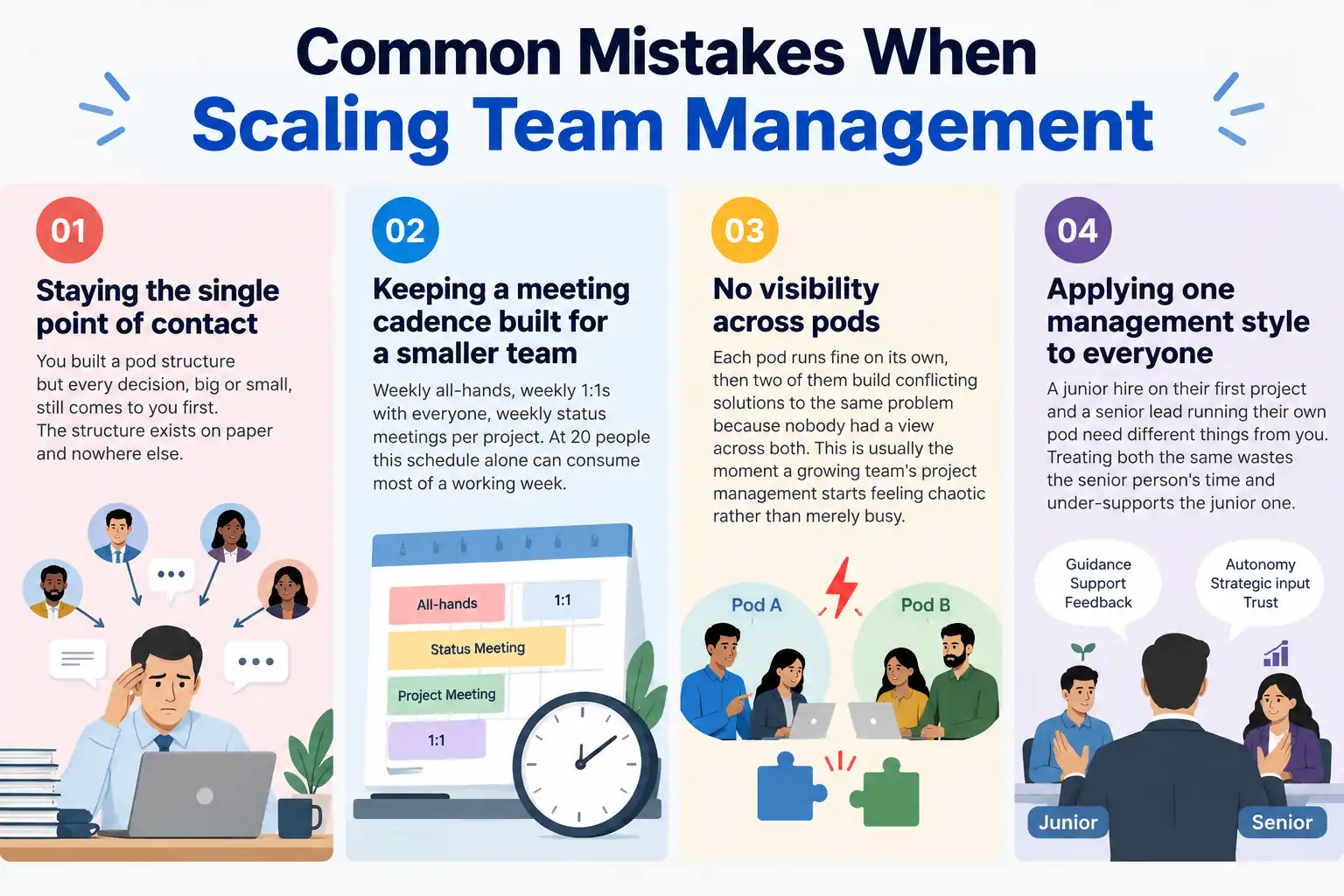
These patterns show up constantly, and not just in growing teams generally, see top 10 project management mistakes in digital agencies for how closely they mirror agency-specific scaling pain.
Staying the single point of contact
You built a pod structure but every decision, big or small, still comes to you first. The structure exists on paper and nowhere else. Documenting decision authority explicitly, the way why you need SOP management software describes, is one of the more durable fixes for this.
Keeping a meeting cadence built for a smaller team
Weekly all-hands, weekly 1:1s with everyone, weekly status meetings per project. At 20 people this schedule alone can consume most of a working week.
No visibility across pods
Each pod runs fine on its own, then two of them build conflicting solutions to the same problem because nobody had a view across both. This is usually the moment a growing team’s project management starts feeling chaotic rather than merely busy, and it’s worth reading why project management becomes chaotic as teams grow and how to fix it if that sounds familiar.
Applying one management style to everyone
A junior hire on their first project and a senior lead running their own pod need different things from you. Treating both the same wastes the senior person’s time and under-supports the junior one.
FAQ
Q. What is the ideal span of control for one manager?
Ans: Most management research puts the practical range at 5 to 9 direct reports before coordination overhead starts outweighing the benefits of direct oversight. Complex, judgment-heavy work sits at the low end of that range; routine, well-documented work can stretch higher.
Q. How many 1:1s can a manager realistically run per week?
Ans: With standard 25 to 30 minute slots, most managers can sustain 8 to 10 quality 1:1s a week without them turning into rushed check-ins. Past that, either shorten the meetings, reduce the frequency, or delegate some of them to leads.
Q. What’s the difference between team management and team leadership?
Ans: Management is the coordination work: assigning tasks, tracking progress, keeping projects on schedule. Leadership is the direction-setting work: building the vision, motivating people toward it. You need both, but they’re genuinely different skills, and a team can have a strong leader who’s a weak day-to-day manager or the reverse.
Q. What’s the best management style for a large or remote team?
Ans: No single style covers a 20-person team well. A mixed approach works better: coaching delegated to leads, transactional clarity on goals and metrics at the team level, and enough authoritative direction-setting from you to keep everyone pointed the same way.
Q. How do you handle underperformance in a large team?
Ans: The same way you would in a small team, just faster, because problems compound quicker at scale. Identify the specific gap, have a direct conversation early, set a clear improvement path with a timeline, and follow up on schedule. Waiting to see if it resolves itself tends to cost more at 20 people than at 5, since one struggling person also slows down their whole pod.
Where to Go From Here
Structure comes first. Communication systems come second, built to fit that structure rather than bolted onto the old one. Management style adapts to who you’re managing and at what scale, not the other way around.
If your team’s project tracking already feels like it’s held together with tabs and reminders, that’s usually the structure problem showing up as a tooling problem. Worth fixing the structure first. The tools get a lot easier to pick once you know what they actually need to show you.
