
Why Managers Need Visibility Into Team Activity
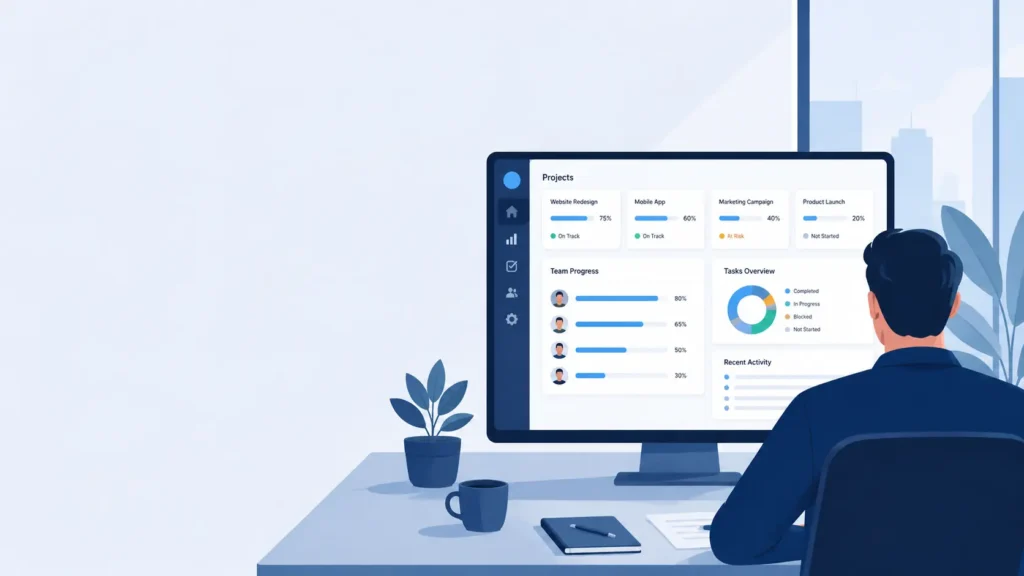
You ask “how’s it going?” in Slack. Someone replies, “Good, on track.” Yet three days later you find out the project’s two weeks behind, and nobody flagged it, because nobody thought to.
That’s the visibility problem in one exchange. Not a lack of tools. Not a lack of trust, necessarily. Instead, it’s a gap between what’s happening and what the manager can actually see, a gap that fills itself with guesswork, extra meetings, and the occasional unpleasant surprise. Solutions offered on Techxaro One help teams bridge this exact gap
Most advice on this topic treats visibility as an unambiguous good: get more of it, get it faster, and your team runs better. That’s mostly true. However, it skips the part that actually matters to a manager reading this at 4 pm on a Tuesday, wondering why their calendar is full of status updates: visibility and micromanagement look almost identical from the outside. The difference isn’t the amount of information a manager has. Rather, it’s what they do with it.
What visibility into team activity actually means
Visibility into team activity is a manager’s ability to see what’s in progress, what’s blocked, and what’s been completed, without asking. In other words, it’s the difference between knowing a task slipped because you can see it on a board, and knowing because someone finally admits it in a meeting three days after the fact.
That sounds obvious written down. Even so, it’s rarely obvious in practice, because most teams don’t lack information. Instead, they lack a shared place to put it. Work lives in five different tools, half a dozen Slack threads, and whatever in someone’s head that morning.
Why managers need it: the core reasons
Accountability without micromanaging
Here’s a pattern that shows up constantly: managers who don’t have visibility default to asking. And asking, however politely phrased, starts to feel like checking up on someone. Interestingly, research published in Harvard Business Review on remote meeting patterns found that as teams adjusted to distributed work, meetings actually became shorter and more efficient rather than falling apart, evidence that structure and visibility can replace constant check-ins without hurting engagement. In short, visibility does the work a status meeting was trying to do, minus the meeting.
When workloads and deadlines are visible by default, on a shared board, not buried in a DM, people tend to hold themselves to a higher bar. This isn’t because they’re being watched, but because the work is legible to more than one person. In effect, it’s a structural effect, not a trust issue.
Spotting overload before it becomes a missed deadline
A manager who can see, at a glance, that one person has six active tasks and another has one can rebalance before either becomes a problem. Otherwise, the rebalancing only happens after someone burns out or a deadline gets missed, and by then it’s damage control, not management.
Reporting up without the scramble
Every manager knows this moment: an exec asks “how’s the migration going?” and the honest answer requires five minutes of digging through three tools before you can say anything useful. With visibility in place, though, that five minutes collapses to zero. It’s a small thing, yet it adds up fast when you’re doing it weekly.
Where visibility crosses into micromanagement
This is the part most advice on this topic skips entirely, and it’s the part that actually determines whether visibility helps or backfires.
The line isn’t about how much a manager can see. Rather, it’s about what the visibility is for. Consider what happens: a manager sets up a dashboard to track task status and deadlines; that’s visibility into outcomes. Alternatively, a manager sets up software to track keystrokes, idle time, and which apps someone has open; that’s visibility into behavior. Both get called “visibility.” Even so, they are not the same thing, and employees can tell the difference immediately.
As a result, a rough but useful check emerges: if removing the visibility tool would make employees relieved rather than indifferent, it’s probably drifted into surveillance.
| Aspect | Outcome Visibility | Behavior Visibility |
|---|---|---|
| What it tracks | Task status, deadlines, blockers | Keystrokes, idle time, app usage |
| The question it answers | Is the work moving, and where’s it stuck? | What is this person doing right now? |
| Effect on trust | Builds it, focus stays on the work | Erodes it, focus shifts to the person |
| Employee reaction if removed | Indifferent, mostly unnoticed | Relieved |
| Typical mechanism | Shared board, a sync updates, dashboards | Screen monitoring, activity logging |
How visibility needs change as your team grows
Visibility isn’t a fixed requirement. On the contrary, it scales with team size in a way that catches a lot of first-time managers off guard. For instance, a 2026 workplace survey covered by KTVZ found that 72% of managers now say tools providing visibility into work progress have become more important than they were a few years ago. Moreover, that number climbs sharply with scale: 79% among managers with more than 50 direct reports, compared to 62% for those managing 1 to 10. Notably, the same survey found that only 9% of managers said these tools were mainly used to monitor employee time or activity; most wanted coordination, not oversight.
Share of managers who say visibility tools have become more important
Source: 2026 workplace survey via KTVZ.
The instinct at ten people is often “I just ask around.” Eventually, though, that instinct breaks somewhere between twenty and fifty, not because managers get lazier, but because the math stops working. Simply put, you cannot personally track fifty people’s status through conversation alone. As a result, what starts as a nice-to-have becomes structural. If you’re a manager who’s scaled a team past that point, you already know the exact week it stopped being optional.
What visibility looks like without more meetings
The mechanism matters more than the tool. For more insights and workflow strategies, explore Techxaro One. With that in mind, a few things consistently work:
First, a shared board where task status is the source of truth, not a person’s memory of the last stand-up. Second, a weekly sync update, written, not spoken, that takes five minutes to write and two to read, instead of thirty minutes of everyone sitting in a call. Finally, dashboards that surface blockers, not just completion percentages, since a task that’s “80% done” and stuck is more useful information than a tidy progress bar.
None of this requires more oversight. Instead, it requires moving the information that already exists (deadlines, blockers, ownership) out of people’s heads and into a place a manager can glance at.
Counterargument: doesn’t this just formalize distrust?
It’s a fair objection. If visibility is introduced as “now I can finally see if you’re working,” it will be received as distrust, and it’ll deserve to be. That said, this is a framing problem, not an argument against visibility itself. In fact, teams that already trust each other tend to want shared visibility, because it removes the burden of constantly narrating your own progress to prove you’re doing the work. Ultimately, the tool isn’t what creates or destroys trust. How it’s introduced, and what it’s used for, is.
The actual takeaway
Visibility into team activity isn’t about seeing more. Rather, it’s about seeing the right things (outcomes, blockers, workload) so a manager can act early instead of reacting late. Get that distinction wrong, however, and the same dashboard that was supposed to save everyone time turns into the thing your best people quietly resent.
So, if you’re managing a team where the honest answer to “how’s it going?” currently requires five Slack threads and a guess, that’s the gap worth closing first.
