
How Agencies Can Manage Multiple Clients Without Losing Track of Deadlines

Running one client account well is hard enough. Running ten, twenty, or fifty at once each with its own approvals process, its own Slack channel, its own idea of what “urgent” means -is a different problem entirely. Most agencies don’t lose clients because the work is bad. They lose them because a deadline slipped, a deliverable got buried under someone else’s, or a project manager was juggling too many spreadsheets to notice a date had quietly passed. This is the operational reality of agency project management: the bottleneck usually isn’t creative talent, it’s visibility into what the team is actually doing. When a team can’t see, at a glance, what’s due, for whom, and who owns it, deadlines start slipping – quietly at first, then all at once. Here’s how agencies that manage multiple clients well actually keep deadlines from slipping through the cracks.
Why Multi-Client Deadlines Break Down in the First Place
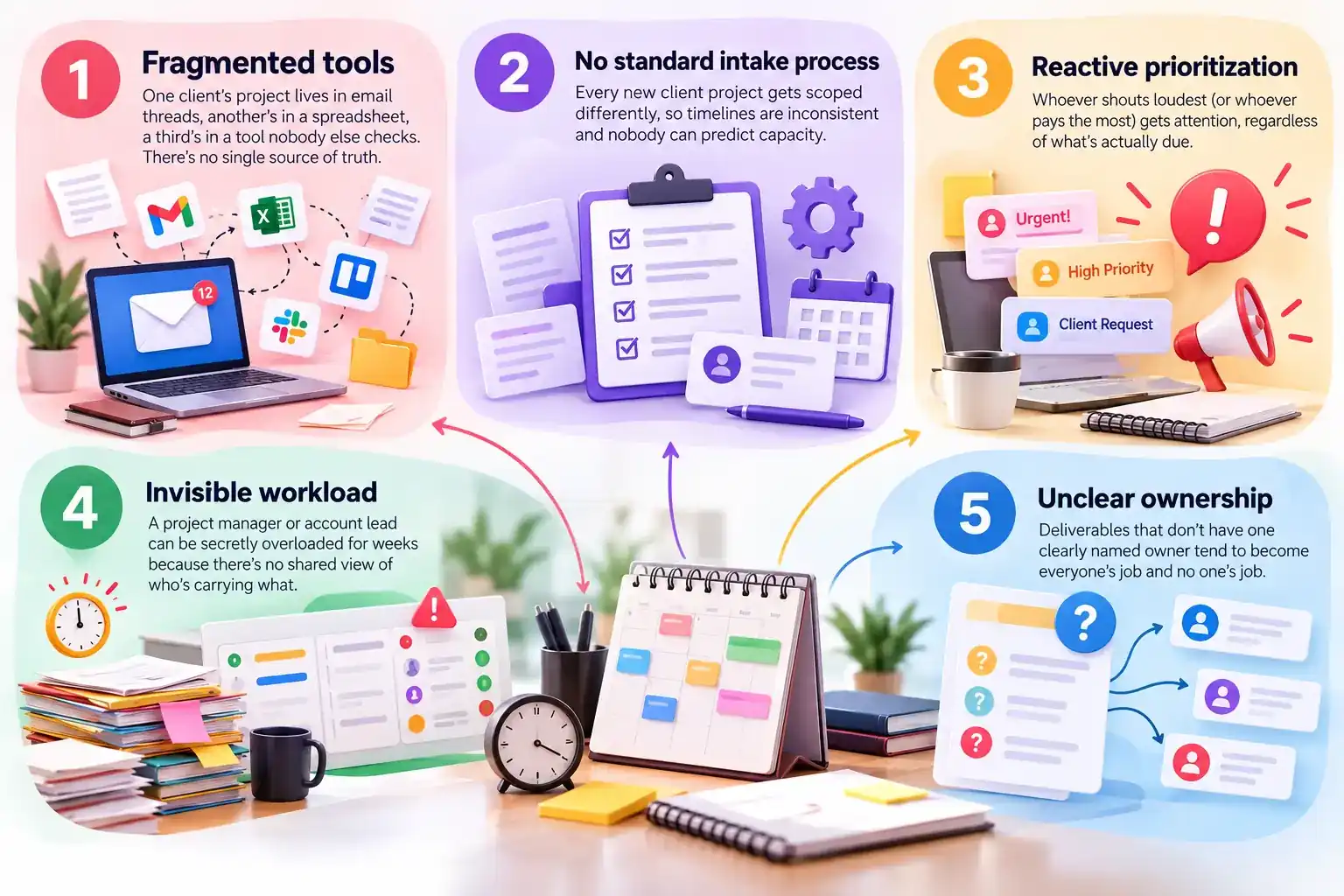
Before fixing the problem, it helps to name it. These patterns aren’t unique to any one agency, they show up across the industry, see top 10 project management mistakes in digital agencies for a broader look. A few patterns show up again and again in agencies that struggle with deadlines:
1. Fragmented tools
One client’s project lives in email threads, another’s in a shared spreadsheet, a third’s in a project management tool nobody else checks. There’s no single source of truth.
2. No standard intake process.
Every new client project gets scoped differently, so timelines are inconsistent and nobody can predict capacity.
3. Reactive prioritization.
Whoever shouts loudest (or whoever pays the most) gets attention that day, regardless of what’s actually due.
4. Invisible workload.
A single project manager or account lead can be secretly overloaded for weeks before anyone notices, because there’s no shared view of who’s carrying what.
5. Unclear ownership.
Deliverables that don’t have one clearly named owner tend to become everyone’s job and no one’s job.
Build One Central System of Record
The single biggest lever an agency has is refusing to let client work live in more than one place. A central project management platform, one built around how teams connect projects, tasks, events, and knowledge in one place, turns “did we already send that to the client?” from a guessing game into a two-second lookup. This doesn’t need to be complicated. What matters is that: Every active project for every client is visible in one tool, not scattered across inboxes and personal to-do lists. Deadlines are dates in the system, not dates in someone’s head. Anyone on the team can check the status of any client’s project without pinging three people first. Agencies that resist this often because switching tools feels disruptive tend to pay for it later in missed handoffs and duplicated work. If you’re still weighing options, how to choose the right project management software for your team walks through what actually matters in that decision.
Standardize the Intake and Onboarding Process
When every new client project starts with a different process, timelines become unpredictable by design. A standardized intake template the same questions, the same timeline structure, the same sign-off steps, applied to every client does two things at once: it protects the agency’s capacity planning, and it sets consistent expectations with the client from day one. A basic intake checklist should capture: Scope and deliverables, defined specifically enough that “done” is unambiguous. A realistic timeline, built from actual team capacity, not client wish-lists. Named points of contact on both sides. Approval and revision rounds, agreed in advance. Dependencies anything the agency is waiting on the client to provide. Turning that checklist into something repeatable is exactly what why task templates save repetitive work and what belongs in a good one covers, and formalizing it agency-wide is where why you need SOP management software comes in. This is where a project manager in an advertising agency earns their keep: not chasing people after the fact, but building a structure at the start that prevents most of the chasing from being necessary.
Use a Visual, Shared Timeline Not Fifty Separate Ones
A deadline that only exists on one person’s calendar isn’t really a deadline the agency can manage. What works instead is a shared visual system a master calendar, a kanban board segmented by client, or a timeline view that shows every active deadline across every account in one place.
This lets an agency answer, instantly, questions like:
- What’s due this week, across all clients?
- Which two deadlines are colliding, and who’s affected?
- Is any single person overloaded next Thursday?
| Approach | Best For | Risk if Used Alone |
|---|---|---|
| Shared master calendar | Seeing all client deadlines at a glance | Can get cluttered without color-coding by client |
| Kanban board per client | Tracking deliverable status within one account | Doesn’t show cross-client workload |
| Capacity/resource view | Preventing team overload | Needs accurate time estimates to be useful |
| Client-facing status page | Reducing “just checking in” emails | Requires discipline to keep updated |
Most well-run agencies combine at least two of these: a cross-client view for leadership and PMs, and a per-client view that account teams and clients can see into.
Assign Clear, Single Ownership for Every Deliverable
Ambiguity is where deadlines go to die. Every deliverable should have exactly one named owner not a team, not “whoever gets to it.” That doesn’t mean one person does all the work; it means one person is accountable for making sure it ships on time, and everyone knows who that is. This is really a structure question as much as a discipline one, see how organizations should structure teams and sub-teams for how ownership maps onto team shape as an agency grows.
This single change tends to surface problems earlier: an overloaded owner will say so well before a deadline, whereas a diffusely-owned task tends to stay silent until it’s already late.
Protect Capacity Before You Sell It
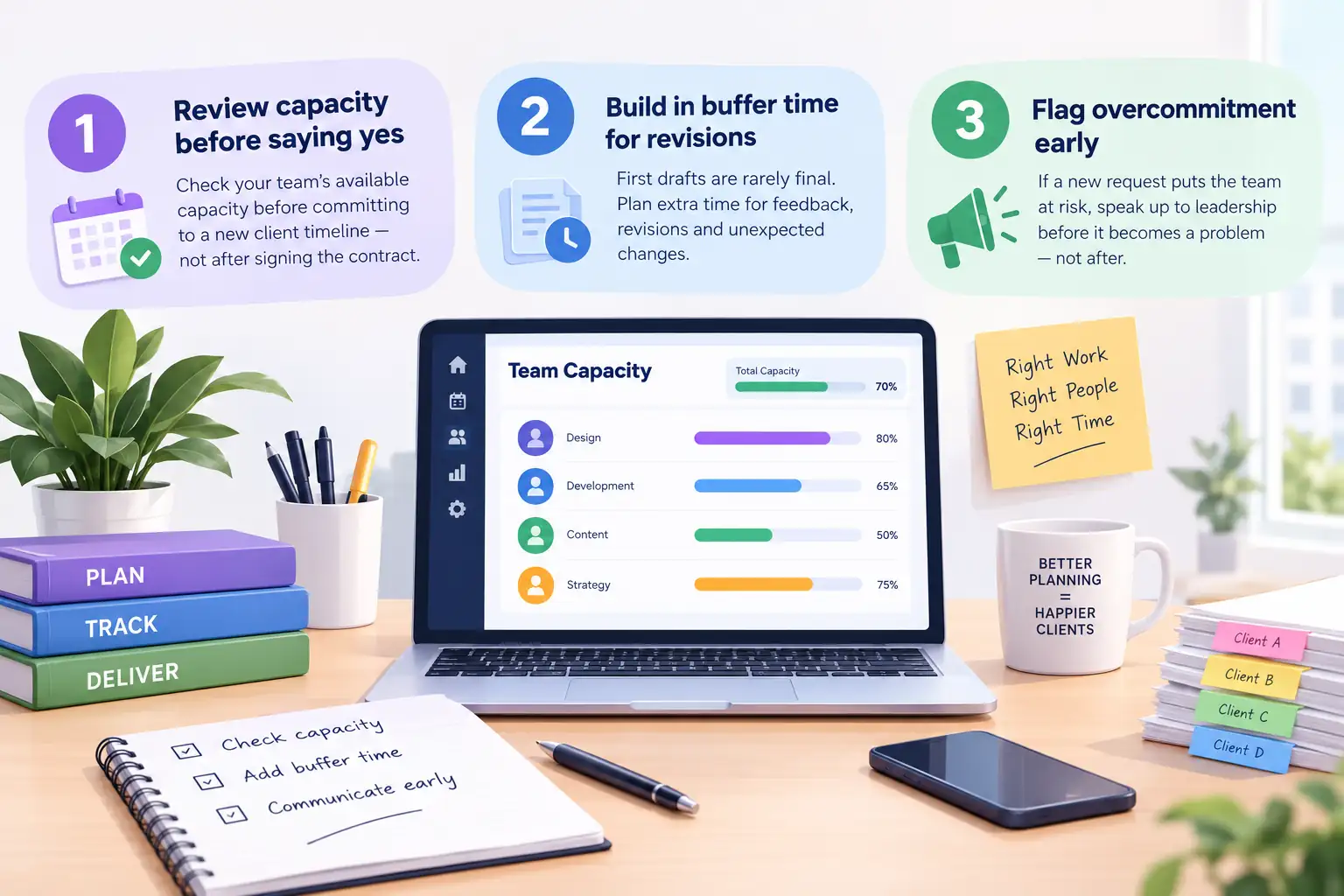
Deadlines slip most often when an agency has said yes to more work than the team can actually deliver. Managing multiple clients well requires treating team capacity as a real, finite resource tracked the same way a budget is tracked rather than something that flexes infinitely under pressure. It’s the same dynamic behind why project management becomes chaotic as teams grow and how to fix it, just triggered by client count instead of headcount.
Practical habits that help:
- Reviewing team capacity before committing to a new client timeline, not after signing the contract
- Building in buffer time for revisions, since first drafts are rarely final
- Flagging overcommitment to leadership early, rather than absorbing it silently through unpaid overtime
Agencies sometimes treat this as a sales-versus-delivery tension, but it’s really a data problem: if capacity is visible, it’s much harder to accidentally overcommit.
Automate the Reminders, Not the Relationships
Recurring deadline reminders, status update requests, and approval nudges are exactly the kind of work that should be automated wherever the project management tool allows it, and automated doesn’t mean noisier, see how excessive email notifications hurt productivity for why more pings isn’t the same as better tracking. A platform like Techxaro One lets project managers submit and track task-level data in one place, so status updates don’t depend on someone remembering to send them. This frees the project manager’s actual attention for the parts of the job that need judgment spotting a scope creep risk, having a hard conversation about a missed client input, re-sequencing work when priorities shift.
The goal isn’t to automate the client relationship. It’s to stop spending human attention on the mechanical parts of tracking, so there’s more of it left for the parts that actually require a person.
Run a Weekly Cross-Client Status Review
A short, recurring meeting 20 to 30 minutes, every week where the team reviews every active client’s status against its deadlines catches problems while they’re still small. This is different from a client status call; it’s an internal check where the agency looks at its full book of work at once, rather than one account at a time.
What this catches that day-to-day work doesn’t:
- Two deadlines quietly colliding on the same day for the same designer
- A deliverable that’s been “in progress” for two weeks with no real movement
- A client who’s gone quiet on approvals, creating a downstream bottleneck
Why This Matters Beyond Just Hitting Dates
There are real advantages of using agencies for ad management that clients care about specialized skill, dedicated capacity, an outside perspective but all of that value collapses if the agency can’t deliver reliably on time. Consistent, visible deadline management isn’t just an internal efficiency exercise; it’s one of the clearest signals of professionalism a client sees. It’s often the difference between a client who renews without a second thought and one who starts quietly shopping for a replacement.
Frequently Asked Questions
Q. How many clients can one project manager realistically handle at once?
Ans: It depends more on project complexity and touchpoints than on a fixed number, a PM juggling five high-touch retainer clients can be more stretched than one running fifteen simple, well-templated projects. The better question is whether workload is visible: if you can’t see how many active deliverables someone is carrying, you can’t answer this safely either way.
Q. What’s the single biggest cause of missed deadlines across multiple clients?
Ans: Fragmented tools. When each client’s work lives in a different place, no one, not even the PM, has a reliable single view of what’s actually due. Most other failure points, unclear ownership, reactive prioritization, invisible overload, get harder to catch once work is scattered.
Q. Should every client be run through the exact same process?
Ans: The intake structure should be standardized, the same questions, timeline logic, and sign-off steps, even if the specific scope and deliverables differ by client. Standardizing the process, not the output, is what keeps timelines predictable without making every client feel like they’re getting a templated experience.
Q. How often should an agency review capacity across clients?
Ans: Weekly is the common rhythm for a cross-client status review, short enough to catch a colliding deadline or a quietly overloaded person before it becomes a client-facing problem, but not so frequent that it turns into another status meeting nobody has time for.
Q. What’s the difference between a client status call and an internal cross-client review?
Ans: A client status call covers one account in depth, from that client’s point of view. An internal cross-client review looks across the entire book of work at once, checking for collisions, overload, and stalled deliverables that no single client-facing call would ever surface.
The Bottom Line
Agencies that manage multiple clients without losing track of deadlines aren’t necessarily hiring more project managers or working longer hours. They’re building systems one shared source of truth, standardized intake, clear ownership, protected capacity, and a regular cross-client review that make deadlines visible before they become emergencies. The work itself doesn’t get easier. But the chaos around it does.
